
Flying a DJI Drone in Thailand in 2026: Registration, Rules and No-Fly Zones Explained
October 15, 2026Thailand is one of the most rewarding countries in Asia to fly a drone: limestone karsts rising out of the Andaman Sea, temple roofs in the northern hills, long empty beaches on the Gulf coast. It is also one of the countries where DJI pilots get caught out most often. The rules are strict, they changed in 2026, and the most common assumption travellers bring with them, that a sub-250g Mini is exempt, is wrong.
This guide walks through what a visiting DJI pilot needs to know in 2026: the two registrations, the insurance, what you can sort out at home, what only works after landing, where you still cannot fly, and the rules for every single flight.
A quick note before we start: rules in Thailand can change with a single announcement. Everything below reflects the position in October 2026, with links to the official sources. Check them again before you travel.
1. Are drones legal in Thailand?
Yes. There is no nationwide ban on tourist drones in 2026. In 2025, drone flying was restricted across a much wider part of the country, and many travel pages and forum threads still describe that situation. On 26 June 2026, CAAT Announcement No. 16 came into force and reopened most of the country. (CAAT is the Civil Aviation Authority of Thailand.)
What Thailand has instead of a ban is a permission system with three parts. All three must be in place before a single flight is legal:
1. NBTC registration: the radio licence for the transmitter inside your drone and controller. NBTC is Thailand’s telecom regulator.
2. CAAT registration: the aviation registration for the aircraft itself, plus a pilot registration with an online exam.
3. Third-party liability insurance: at least 1,000,000 THB of cover, which CAAT checks before it registers the drone.
On top of that, every flight now needs its own request (more on that in section 7).
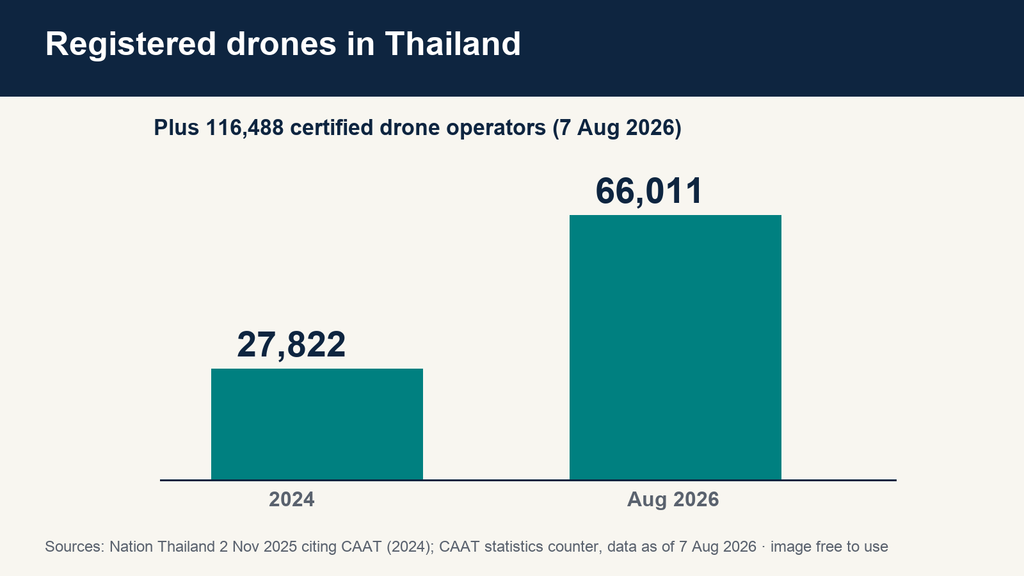
You will not be the only one in the system. CAAT’s own statistics counter showed 66,011 registered drones and 116,488 certified drone operators (101,644 basic level, 14,844 advanced level) as of 7 August 2026.
2. The 250g myth: your DJI Mini is not exempt
This is the single most important point in this article for DJI owners.
In the EU and the United States, a drone under 250 grams avoids most registration duties. Thailand has no such exemption. Any drone that carries a camera needs both registrations, whatever it weighs. The DJI Mini series, the DJI Neo and the DJI Flip are all covered, in exactly the same way as a Mavic or an Air.
Weight still matters in Thailand, but for other things: how far you must stay from people (see section 8) and what your insurance costs. It never removes the duty to register.
If you are packing a Mini because you think it lets you skip the paperwork, plan for the full process anyway.
3. The two registrations: NBTC and CAAT
Thailand splits drone registration between two authorities, and it helps to understand why.
NBTC: the radio side
Your drone and its controller both transmit radio signals. NBTC registers that transmitting equipment, so it needs details of both the aircraft and the controller. You apply online at anyregis.nbtc.go.th using the path for foreigners. NBTC charges a one-time fee of 200 THB (as published on 4 August 2026; check the current amount before you budget). It is paid after your application is approved: NBTC emails a payment form, which you print and pay in cash at a Thai bank counter. No Thai bank account is needed, but not every bank can process the form. Krungthai is the bank most commonly reported as accepting it. Approval typically takes one to three working days.
CAAT: the aviation side
CAAT registers you as a pilot and your drone as an aircraft, through its UAS Portal (uasportal.caat.or.th). CAAT charges no government fee for recreational pilot and drone registration. The pilot registration includes an online exam:
– 40 questions
– 30 correct answers (75 %) needed to pass
– a 24-hour wait before a retake if you fail, with no limit on attempts
– the exam is free, retakes included
The exam is personal: you sit it yourself. Once you pass, the pilot registration is valid for two years. The drone registration is completed after NBTC has approved your equipment, and it includes the Specific Category (Rotorcraft) rating. The drone registration number does not expire unless it is cancelled.
The order matters
NBTC approval comes before the CAAT drone registration, so you cannot finish CAAT while NBTC is still pending. Start NBTC on day one.
4. Insurance is a legal gate, not a nice-to-have
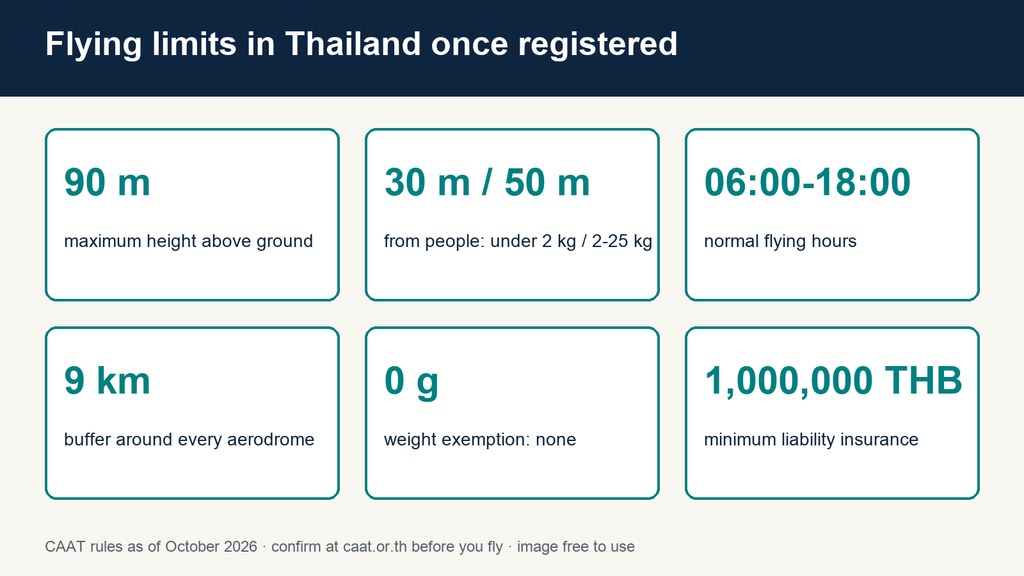
CAAT requires third-party liability insurance of at least 1,000,000 THB before it will register your drone. Above 25 kg the minimum doubles to 2,000,000 THB, which hardly any traveller will ever need.
Many pilots assume something they already have covers it. Usually it does not:
– Travel insurance almost always excludes drone operation.
– DJI Care Refresh repairs or replaces your own drone. It covers no third party at all, so it does not meet CAAT’s requirement.
– Credit card purchase protection does not cover liability to others.
– Most home-country drone policies do not count unless the wording explicitly extends to Thailand.
What you need is a policy in your name, valid in Thailand, with at least 1,000,000 THB of third-party liability, and with dates that cover your flying days. Give the dates some room: cover that starts on landing day and ends on departure day leaves no space for the days registration takes.
Insurance is also the one part of the process you can finish before you leave home.
5. What you can do before you fly, and what has to wait
The biggest planning mistake is assuming you can register online from home and land ready to fly. You cannot. Both registrations need two things you only get in Thailand:
– the entry stamp in your passport (NBTC’s key requirement), and
– a Thai mobile number that can receive an SMS code (CAAT’s key requirement).
A Thai SIM bought at the airport works. A Thai eSIM may work too, but not every eSIM receives the verification code reliably. A foreign number does not work, and neither does a data-only plan with no Thai number.
So the work splits into two halves.
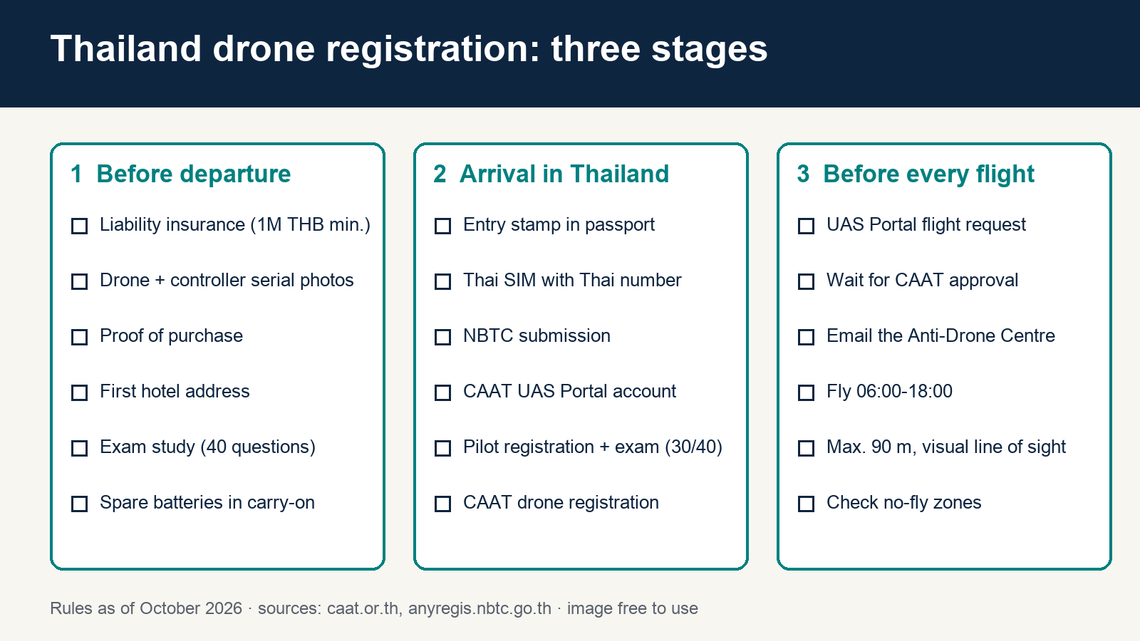
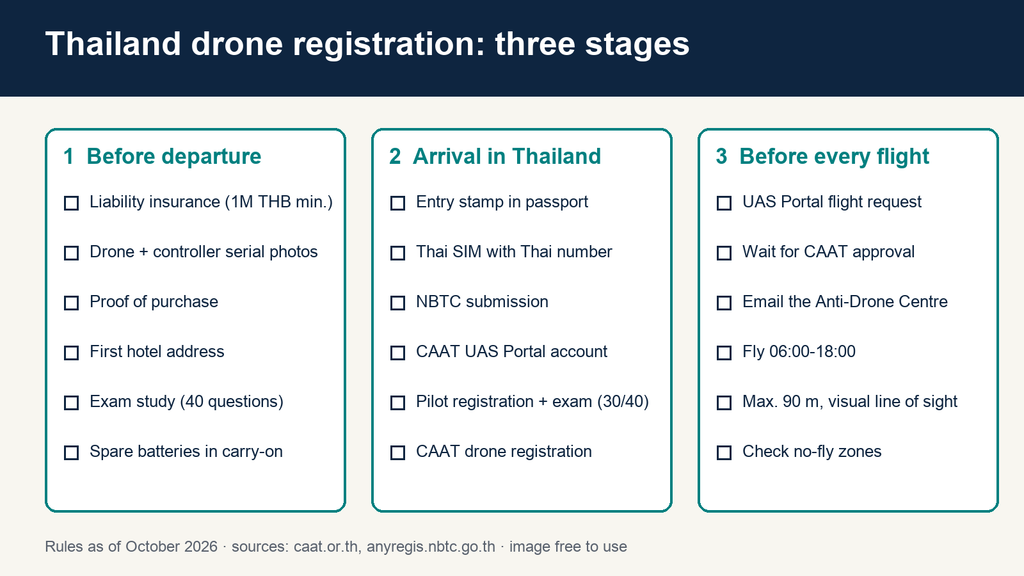
Before departure
– Arrange the liability insurance (see section 4).
– Check that your passport is valid for your stay.
– Take sharp photos of your drone’s brand, model and serial number, and of the controller’s serial number. Check them on a proper screen, not just your phone: a serial that looks sharp on a phone is often soft when you open it properly.
– Find your proof of possession: the purchase receipt or an equivalent. For a gifted or second-hand drone this is much easier to sort out from home than from a hotel room.
– Note the address of your first hotel. NBTC needs an address in Thailand.
– Start preparing for the 40-question CAAT exam.
– Pack spare batteries in your carry-on (section 6).
Arrival day and the first working days
– Get the entry stamp at immigration and photograph the stamp page. That is a different page from the passport photo page, and you need both.
– Buy a Thai SIM with a Thai number.
– Submit to NBTC.
– Create your CAAT UAS Portal account, verified through your Thai number, and submit your pilot registration.
– Pass the exam.
– Once the NBTC certificate arrives by email, complete the CAAT drone registration.
Keep the name the same on every document. A shortened first name on the insurance and the full name on your passport is a classic reason for a submission to come back.
If you want everything on one page to print or keep on your phone, there is a free Thailand drone registration checklist (https://www.droneclearthailand.com/thailand-drone-registration-checklist) that follows exactly this order, from packing to your first legal flight.
What “done” looks like
You are ready to fly when you hold all of these:
– the NBTC certificate covering the drone and controller you actually brought
– your CAAT pilot registration, exam passed
– your CAAT drone registration with the Specific Category (Rotorcraft) rating
– your insurance certificate, in your name, valid in Thailand, with dates covering your flying
– your registration number displayed on the aircraft, in characters at least 3 mm high for drones under 25 kg
Keep digital copies of the documents on your phone whenever you fly.
6. Getting your DJI drone to Thailand: batteries and customs
The flight itself is the easy part, as long as you follow the international lithium battery rules. They apply on every leg and every airline:
– Spare batteries travel in the cabin only, never in checked baggage.
– Up to 100 Wh needs no airline approval. Nearly all DJI Mini, Air, Avata, Neo, Flip and Mavic batteries fall into this class. Check the Wh figure printed on your battery.
– 100 to 160 Wh needs airline approval and is normally limited to two spares.
– Over 160 Wh is not allowed on passenger aircraft.
– Protect the terminals: original packaging, a LiPo bag or tape over the contacts.
The drone itself may go in carry-on or, with most airlines, in checked luggage with the battery installed and the drone switched off. Carry-on is the safer choice because it avoids handling damage and airline-specific surprises. Power banks for your phone or controller follow the same lithium rules: cabin only.
A connection in Doha, Dubai or Singapore changes nothing. The same battery limits apply on the second airline as on the first.
At Thai customs, a personal drone needs no declaration and no special form. Walk through the green channel; there is no duty on personal equipment you take home again.
7. Before every flight: the UAS Portal request and police notice
This is the part that catches out pilots who registered in Thailand before 2026. Registration is no longer a blanket licence to fly whenever you like. Under CAAT Announcement No. 16 of 26 June 2026, in force until further notice, every flight is requested and notified:
1. Request approval in advance through the CAAT UAS Portal, with the flight area, date, time and purpose. You may fly only after CAAT approves. The Thai Government’s public relations department and TAT News both report a lead time of at least three days.
2. Notify the Anti-Drone Centre of the Metropolitan Police Bureau by email (antidrone.police@gmail.com) before each approved flight, with the same area, date, time and purpose.
3. Keep to the flying hours reported by the same sources: 06:00 to 18:00 is the normal window. 04:01 to 05:59 and 18:01 to 24:00 need special permission. 00:01 to 04:00 is not permitted.
The practical consequence for a holiday: plan your shooting days at least three days ahead. Sunrise shots before 06:00 need special permission. A spontaneous “the light is perfect, let’s fly” no longer works.
8. Flying limits once you are registered
Registration gives you permission to fly. The operating rules still apply:
– Height: maximum 90 metres above ground level.
– Line of sight: the drone must stay visible to your own eyes. Watching the screen or wearing goggles does not count, which matters for Avata and other FPV pilots.
– Distance from people: 30 metres for drones under 2 kg, 50 metres for drones from 2 to 25 kg. That covers uninvolved people, vehicles and buildings.
– Airports: a 9 km buffer around any aerodrome, temporary airfields included. Inside it you need written CAAT permission plus approval from the airport or airfield operator, applied for roughly two weeks ahead.
– General duty: no flight may endanger life, property or public peace.
The 9 km airport ring is bigger than most people expect. It takes in most of central Phuket, large parts of Koh Samui and a surprising amount of Chiang Mai.
9. Where you still cannot fly
Thai restrictions come from several authorities, not one master list, which is why online advice so often contradicts itself. These are the ones that matter to a travelling DJI pilot.
Border districts under Announcement No. 16
Announcement No. 16 left 28 named districts closed across seven border provinces: Sa Kaeo, Surin, Buriram, Sisaket, Ubon Ratchathani, Trat and Chanthaburi. Read that carefully: the restriction applies to the named districts, not to the whole provinces. Being in Trat province does not automatically mean you cannot fly. Being in one of the listed districts does.
Koh Chang, Koh Mak and Koh Kood
These three islands sit inside VT P38, a Royal Thai Navy prohibited area, active from sunset to sunrise. The Aeronautical Information Publication lists it as “Ko Chang – Ko Khud”, from the ground up to 5,000 ft, with entry only for aircraft the Royal Thai Navy has authorised. It is separate from any CAAT announcement, so it does not change when CAAT reopens or closes districts.
National parks
Thai national parks are run by the Department of National Parks, not by CAAT. Flying inside one requires a separate park permit. Your CAAT registration does not grant it. Koh Phi Phi and the Similan Islands are the two that catch photographers out most often.
Palaces, government and military sites
VT R3 covers the palace area in Hua Hin with a restricted zone of one nautical mile. Government buildings, hospitals and military installations are off limits more generally.
10. Is there an official Thailand drone map?
No single official map covers everything. Restrictions come from at least four separate sources: CAAT for aviation, the Royal Thai Navy for prohibited areas like VT P38, the Department of National Parks for parks, and the Aeronautical Information Publication for controlled airspace. No single body publishes a combined layer.
Some practical points for DJI pilots:
– DJI’s geofencing reflects DJI’s own data, not Thai law. The app may let you take off inside a restricted district, and it may block you somewhere that is legal. Treat it as a safety aid, not as permission.
– The Drone Association of Thailand publishes a no-fly-zone map that is a reasonable starting point, but it is not the legal source.
– Maps from blogs and shops go stale fast, especially after a change like Announcement No. 16.
– The authoritative position for any specific spot is the current CAAT announcement plus the Aeronautical Information Publication.
11. A realistic timeline for a holiday
For a well-prepared traveller, the registration part after landing has taken one to two working days in our experience; NBTC approval alone typically takes one to three working days. Add the at-least-three-day lead time for your first flight request, and a sensible plan looks like this:
– Before you leave: insurance, photos, receipts, hotel address, exam study, batteries packed in your carry-on.
– Day 1 in Thailand: entry stamp, Thai SIM, NBTC submission, CAAT account and pilot registration, exam.
– Days 2 to 3: NBTC certificate arrives, CAAT drone registration completed, first flight request submitted.
– From about day 5 or 6: first approved flight (at least three days after the request), with the police notice sent beforehand.
On a two-week trip that is very manageable. On a long weekend it usually is not, so check that the timing works before you pack the drone.
12. Quick FAQ
Do I need to register a DJI Mini in Thailand?
Yes. Thailand has no sub-250g exemption. Every camera drone needs both NBTC and CAAT registration, plus liability insurance.
Can I register online before I travel?
Only partly. You can arrange insurance and prepare your documents at home, but both submissions need your Thai entry stamp and a Thai mobile number.
Does DJI Care Refresh count as insurance?
No. It covers damage to your own drone, not third-party liability, which is what CAAT requires.
How high can I fly?
90 metres above ground level, within visual line of sight.
Can I fly at sunrise?
The normal window is 06:00 to 18:00. Flights from 04:01 to 05:59 need special permission.
What happens if I fly without registering?
You would be flying an unregistered aircraft, and Thai law provides for fines and confiscation. It is not treated as a paperwork slip.
Final thoughts
Thailand rewards the pilots who prepare. Sort out insurance, documents and battery packing at home. Plan a few working days after landing for the two registrations, and remember that every flight now needs its own request and police notice. Do that, and your DJI drone can come home with footage from one of the most photogenic countries in the world, without any trouble with the authorities.
Official sources to bookmark before you travel:
– Civil Aviation Authority of Thailand (CAAT): https://www.caat.or.th
– CAAT UAS Portal: https://uasportal.caat.or.th
– NBTC registration portal: https://anyregis.nbtc.go.th
– AIP Thailand, ENR 5.1 (prohibited and restricted areas): https://aip.caat.or.th/2026-10-01-AIRAC/html/eAIP/VT-ENR-5.1-en-GB.html
—
About the author: Joe writes for DroneClear Thailand (https://www.droneclearthailand.com), a drone registration and insurance service based in Hua Hin, Thailand.